8/22/2022

A Woven Basket with Others: An Interview with Isabella Wang

The following interview is part four of a seven-part series of conversations with BC poets which I released between January and April 2022. All eight interviews were originally posted at ReadLocalBC.caThis was the third year of my collaboration with Read Local BC (you can read the 2019 interviews here, the 2020 interviews here, and the 2021 interviews here).

---


Ghazal for Heirloom Family Recipes - Isabella Wang

My grandmother taught me five different ways to deflesh a bitter gourd,
how to scrape off the residue left from seeds so it would taste less bitter.

Recipe for old-fashioned liquor: Replace the sugar cube with elderberries.
In an ice-filled mixing glass, stir bourbon, St. Germain and bitters.

The best coffee was served to me by a young woman at the Ethiopian café—
it was sweet on its own, and permeated all the necessary tinges of bitterness.

When you leave water in a cup for too long, it evaporates. Can’t say
the same about honey, but it’s beginning to clump. Tea leaves turn bitter.

My grandfather died while eating crab and red wine—heart attack.
This is a spell we are currently under, but I promise it won’t stay bitter.

Reprinted with permission from 
(Nightwood Editions, 2021)

---


---

Rob Taylor: Near the end of Pebble Swing, you write about “friendly grins / tugging on the tight fabric masks,” and note that it’s “A year of the same weekly / appointments, missed blood tests. // The doctor sends requisition after requisition…” The poem (“August”) speaks well to our current COVID moment, but also to your particular medical challenges in recent years (Pebble Swing having been released prior to your cancer diagnosis and subsequent surgery). How has it felt to have these two health uncertainties — one collective, one personal — play out at once?

Isabella Wang: Oh boy, yeah… Both these events in my life have brought immense, as you put it, “uncertainties.” These past few years have just been surreal, in the sense of both being a witness to the world, and my community’s collective experiences of grief and crisis, while undergoing my own. It’s a strange feeling, at a time when we are all physically distanced, to see and hear about loss, illness, and other forms of pandemic-induced tumults every day and then realize I am part of this too. I feel this.

When the pandemic struck, it affected my housing — I moved four times just in the summer of the first wave — and like many poets, not being able to attend in-person events at a rhythm that used to provide us with so much nourishment and support was hard, on both my mind and my creativity. So, at the time when I wrote “August,” I was experiencing symptoms of major depression, housing instability, and severe exhaustion. At one point, that fall, I was waking up at 2 pm and sleeping again by 6 pm. I had a feeling that something was wrong, but you know what it’s like — at 21, generally healthy, my symptoms were easily dismissed for anemia and depression, and I guess I didn’t reach out to as many healthcare professionals as I would have because I knew that clinics and ERs were already understaffed.

Not knowing it was cancer, I didn’t want to take away from resources. But it was true: at the hospital where I had my surgery to remove the malignant tumour early this new year, there was an Omicron outbreak and me and other patients could tell how tired, overworked, and worried the nurses were. They took wonderful care of us, and even if it was to get more pain meds or help sitting up, we often didn’t ring for help when we should have because we didn’t want to disturb them too much. The empathy was mutual.

RT: I can imagine. That must have been incredibly difficult. How did it feel to finally have an answer to why you were feeling so unwell?

IW: Finding out about the diagnosis four days before Christmas was hard, when all the doctors’ clinics and a lot of resources were not accessible, and during another personal housing crisis. I think the hardest part was waiting for a surgery date. I knew that I had an aggressive tumour (they usually are aggressive in younger folks), and if it spread before the surgery my whole life would change. So, that was hard — the toll it took on my loved ones, and feeling helpless to do anything about what was going on in my body.

I think Dr. Linda Thyer at SFU health and counselling is the real hero in all of this, and I wish there was just a way to thank her, more than saying the many thank yous I have already expressed. She saved my life. I haven’t had a family doctor since I was 10, so she didn’t know me or have my long-term medical records. I came in as a walk-in for an unrelated symptom, and she sent me for a thorough scan that then accidentally discovered the tumour, literally just in time. After the diagnosis, she was also working overtime, calling me during after-hours to make sure I was okay. And then another miracle happened. I got a call early in January telling me there had been a cancellation. That I was scheduled for surgery in three days. It was a successful surgery. When my loved ones got the news, they all cried. I was relieved to see them breathe a sigh of relief.

RT: How does it feel to finally have some form of resolution, even if your full recovery is still a ways off?

IW: I think I’m doing good. I have been dealt a difficult hand of cards, but I know now that I have also been dealt a lot of fortunate things. I am grateful for my doctors and the support of my community at a time when I so needed them. I am grateful for miracles, to be recovering well, and after moving twenty times in the past three years, to have finally moved in to what I think will be a long-term home.

RT: In Pebble Swing you write “I’ve planted flowers / Phyllis, so they may appear in future hours, and surprise me.” In the months and years after their first book is published, most poets look back at what they’ve written — the flowers they’ve planted — and are surprised! You’re a few months post-book now, but in your case it’s been a very eventful few months. Looking back at the book, what are you surprised by?

IW: The one thing that surprises me the most is my audience, be it readers on the page, or listeners at a live or Zoom reading. As you say, a lot has happened. One of my professors once observed that Pebble Swing has many voices, and that is a reflection of my perspectives and experiences shifting a lot over these eventful years of my undergrad. A lot has continued to change, including my poetry voice and style, working with two new manuscript projects. So, even though I personally feel like I relate a lot more to my current poetry and recent events in my life — because, of course, that’s how we write and grow — it’s still really moving to encounter readers of Pebble Swing of different ages, and through different contexts, and be told that what I wrote during this phase of my life has resonated them, or comforted them. It’s the greatest gift I find myself receiving from pursuing this work.

Another surprise, since you bring up Phyllis Webb, was that even though I had never met her in person, she knew of me and the work I was doing responding to her ghazals. Pebble Swing was the last book she had read before she passed away last Remembrance Day. I still think about her, and often talk to her, every day.

RT: Oh yes, how frivolous all of the concerns of the book “business” appear next to a beloved writer loving your work. It’s everything, eh? I’m so glad you were able to have that relationship with Phyllis Webb, both on and off the page.

How has it felt to put a book out during COVID? All writers who’ve put a book out during this time have had to mix celebration and grief together in some way, but that feels especially true in your case.

IW: Well, I guess I was lucky that my medical treatment didn’t get in the way of Pebble Swing’s launch celebration so much, and equally lucky that I was able to have a joint in-person launch with my talented friend, Ellie Sawatzky and her collection, None of This Belongs to Me, who I know you interviewed earlier in this series. So many of my dearest, most beloved friends came to that launch, and my partner, Scout, was also able to attend before they headed for Waterloo. It is one of my favourite memories.

I remember, at the time of the launch, I had just been informed that a tumour had shown up on my ultrasound, unexpectedly. Given my age and other factors, my doctor was able to give me peace of mind that what I had was probably the most common benign tumour or cyst; even though the result turned up otherwise a month later, I am grateful to have had that extra month right around my book launch where I didn’t have to be too worried yet. I think if I had known beforehand, and my friends and loved ones had known, the diagnosis would have gotten in the way of a “normal” celebration that I, like many poets, had worked very hard for.

RT: I’m so glad you managed to create that momentary safe space for celebration. All poetry book launches feel like little miracles in one way or another, yours especially.

In one of your book’s most powerful poems, “I Remember,” you write about Li Bai’s “静夜思” (“Quiet Night Thought"). It’s one of my very favourite poems, but as a poem about dreaming of one’s homeland, it must resonate differently for you than it does for me (translator Arthur Cooper stated in the ’70s that it must be the best known poem for Chinese people living overseas). You write, “I remember looking at the distance we’ve crossed / and the distance a poem / still has to voyage to make it in translation.” Could you talk about coming to that poem, and to Chinese poetry more generally, and how they helped you feel more connected to your personal and cultural history? What of each (the poems, the history) inevitably gets lost in translation?

IW: Aww, thanks Rob! I’m so glad this poem resonated with you, and I didn’t know the name of Li Bai’s poem translated to “Quiet Night Thought.” This poem started in Dr. Lindsey Freeman’s “Spaces of Memory” sociology class. For the first class, Dr. Freeman got us to read an excerpt from Joe Brainard’s I Remember — a book of poems that starts each line with the words “I Remember.” That still is one of my favourite books. For an exercise, we were instructed to list fifty lines the way Brainard had done, beginning with “I remember.” I got inspired to write my poem.

For years I had been struggling to find the right form and words to express the emotions I felt surrounding my family’s story and involvement in the Chinese Cultural Revolution, which took the life of my grandmother. Brainard gifted me with the form, and after that, the words just flowed. When I think about what I remember, those memories are inherently mixed with sentiments of forgetting; in the spaces of a few words of my mother tongue that I still possess, there are gaps of what I am no longer able to express in that language.

In the story of what I know about my family’s ancestral history, there are chasms of intergenerational narratives lost with my grandmother, lost in my forgetting of language, that I long to fill. I translate, but the untranslatable is ultimately what gives me the momentum for poetry — the trying; reaching toward a horizon that always ends up blurry, in metaphors with a double-edge.

RT: I’m so glad you are writing in and around those spaces. We all carry such gaps with us in one way or another, but it’s so valuable to stop and look at what was lost, and what still exists around them.

The pain of separation sits near the heart of Pebble Swing. Having written about so many types of separation (from culture, from language, from family, from community…), I’m curious if you have thoughts on what poetry can do about them. Can poetry only acknowledge the pain of separation, or can it in some way help soothe the pain, or bridge the gulf?

IW: I’ve been using caesuras a lot. My caesuras signify breath, rhythm. In poems such as “Synapses and Grass,” caesuras also compose visual fragmentation and the loss of memory — perhaps, separation, as you say. Recently, however, while caesuras are still very prevalent in my poems, they also serve as different forms of bridges: not so much closing any gaps as much as offering a way to cross them, to learn through wading across the lessons that separations offer us. I talk about them in this poem, as part of a new manuscript I’m working on called Choreography of Forgetting. That manuscript traces the choreography of strokes of Chinese characters to tell a story. It’s my way of reclaiming my mother tongue in the only way that I know how, through poetry, the form of expression where I feel most at home. A way of bridging the gulf that emerged in my entire family, not just an immigrant like I, when the Chinese Cultural Revolution took away my paternal grandmother.

RT: We’ve already talked a bit about one real-life way poets bridge the gaps between one another: book launches, readings and other social gatherings. The old truism is that poets don’t make money, but they have the best parties!

Many writers only slowly come to understand the importance of community in their (otherwise often very isolated) writing lives, but you seemed to “get it” right away. You’ve volunteered and worked at magazines, reading series, university programs, you name it. And if you’re not hosting or organizing, you’re an enthusiastic presence in the audience. Could you talk about diving into the poetry community, and how that’s influenced the trajectory of both your writing and your life?

IW: Well Rob, you are at the heart of how that story began. I was sixteen, in my last year of high school, when I sought out the weekend poetry workshop that you and Evelyn Lau were teaching with SFU Continuing Studies. It was under your mentorships that I learned not only about the craft of writing and editing my own work, but about the work that was out there in the community by other local poets whom I didn’t know anything about at the time, as well as how to get involved through literary readings and volunteering. At first, when I didn’t know a lot of people, I would just go to your events as you shared them on Twitter. While there, however, I would meet lots of new poets who would invite me to other events, and that’s how I learned to get out there in the community.

I remember going to your book launch for Oh Not So Great, probably my second time attending a literary event ever, and I was so excited about it that I had arrived on scene like an hour early. You had me helping out, setting up the refreshments and greeting folks at the door. That was probably my first time “volunteering” in this community that I grew to really love, and so, more occasions followed.

In reading the work of other poets in I’ve connected with at events, I’ve learned a lot about craft and what it means to read words that move you. The people in the community, my friends and loved ones, have also offered me many generous lessons on caring, listening, reciprocating, and what it means to hold one another. They’ve taught me how to take turns being a woven basket with others. I’ve grown so much as a person over these years, and I mean, money gets you certain necessities in life, but these human experiences with other writers have been equally, if not more, enriching.

RT: I love that image of the woven basket. You mentioned your partner, Scout, earlier, and your interweaving closes the book: Pebble Swing’s last poem is a love poem. The poem is directed both to Scout and to sunflowers, of which you note “Only young flowers move; only young flowers have to.” Sunflowers seem to have become your motif, as seen in your author photo and the cover of a recent chapbook of poems dedicated to you, Calling to the Sun: Poems for Isabella Wang. What attracts you to sunflowers? What can they teach us about love?

IW: Sunflowers are Scout’s favourite flowers, for one thing. They don’t demand for a lot, but always try to offer more than they take in: you can plant sunflower seeds almost anywhere. But when they grow up, they are tall, sturdy, and magnificently beautiful. Their petals make people happy. Their seeds can also be roasted and consumed. I’m also thinking about this absolutely profound story that I think will resonate in people’s hearts for a long time, about the Ukrainian woman offering Russian soldiers a handful of sunflower seeds for their pockets, telling them that when they die, at least sunflowers will grow over the land that they’ve invaded and devastated, making her home beautiful again.

---

Isabella Wang is the author of the chapbook On Forgetting a Language (Baseline Press, 2019). She has been shortlisted for The Malahat Review’s Far Horizons Award for Poetry and Minola Review’s Poetry Contest, and was the youngest writer to be shortlisted twice for The New Quarterly’s Edna Staebler Personal Essay Contest. She studies English and world literature at Simon Fraser University and is an editor at Room magazine. Pebble Swing is her debut full-length poetry collection. She lives in New Westminster, BC.

8/08/2022

A Gift of Mystery and Many Hands: An Interview with shauna paull

The following interview is part three of a seven-part series of conversations with BC poets which I released between January and April 2022. All eight interviews were originally posted at ReadLocalBC.caThis was the third year of my collaboration with Read Local BC (you can read the 2019 interviews here, the 2020 interviews here, and the 2021 interviews here).

---


as you come to dust - shauna paull

let its settling be rare
let it carry the great, low hum of mountain
tune of sap      notes of summer
leaves under high tide pull, under low
that hush before the opening of wings

let it caress, as hands have done, the bare feet of a fraught child
an adventuring child
let its sparks of want, want     burn softly away
let its final quiet be a listening, solace for difficult necessary voices
let its listening protect the ones who remain
let it rest, lift, soften the edges of wind, lift again
and be carried

Reprinted with permission from 
(Mother Tongue Publishing, 2021)

---


---

Rob Taylor: So many of the poems in blue gait feel timeless: they deal with abstract, existential questions that we as a species have been asking of ourselves since time immemorial. But another stream of poems in the book is tightly bound to the political world of the here and now, centred around particular injustices (such as the confirmation of the 215 children buried at Kamloops Indian Residential School or the ongoing actions at the Unist’ot’en Camp). In these poems you speak very specifically and politically.

These two “modes” seem to mirror your larger life, in which you work as both writer and activist. Could you talk about these two “modes” in your writing: the abstract/eternal and the political/immediate? Do you think of them as distinct from one another, or as part of an indivisible whole?

shauna paull: Thank you for this question, Rob. I think I mostly resist separations between art and world. In the presence of my community work, which was political as well, my most fervent hope was to create access to abundance for the highest number of people. It’s natural then that the work emerges from ontological concerns and enlarges to encompass the concerns of those whose lives are marked by xenophobia of one sort or another. I am aware that some of the poems that address what is present in the “here and now” are doing so because the stories of alterity that open in them are longstanding.

I think song is the one thing that can cross just about every barrier — what moves a space of air cannot be contained by any regulatory or political body, or set of convictions. For me, these poems are a small attempt at creating song-space for witness — my own. This space is limited in various ways, but my hope is to honour what remains alive in the communities I am engaged with and hope to support.

The root values of well-being, autonomy, and dignity for all, will likely always be central to my thinking and making. It’s possible that a practice of paying attention with one’s heart is present in the work, too. Nobody is really safe until we are all safe. At this point in time, I carry an awareness that witness will always be needed, but also celebration and beauty and kindness, all of which are under-sung in the dominant myths of our country and in capitalism. Simplicity and relational attentiveness take time and care and it seems to me, from almost every direction, these benefit humanity.

RT: In blue gait you make space not only for the historical and ongoing injustices experienced by Indigenous peoples in Canada, but also draw upon the words of a number of Indigenous poets, from Joanne Arnott, to Gregory Scofield, to Leanne Betasamosake Simpson. Could you speak to the importance of Indigenous history and voices in your life, and in this book in particular?

sp: My undergrad was focused on post-colonial literatures so I am aware now that although I had to read Eurocentric canonical texts alongside, I was able as a young person to access world literatures, literatures of liberation and resistance, as well as Indigenous literatures from across the globe. I am grateful to have been opened in my early learning to stories that unsettled individualism as a value and, again and again, enlivened ideas of communities working together for larger substantive change.

I think current Indigenous writers share with us a world view that has been responsible for the stewardship of lands, and particular connections with the land (and each other) that are essential for all of us to understand. Those stories are also longstanding. Across time, and especially now, they have been great gifts toward my thinking and making.

My community work has for years located me near Indigenous leaders and Elders as well. I have had the great gift of being invited into ceremony, for which I am grateful, and there it’s impossible not to witness the wisdoms of the people of these lands. The necessary work of reconciliation and decolonization will be long, but I locate this as the most important conversation of our time. In writing this book, I was accompanied by all these gifts. My hope is that the respect I have for Indigenous communities that work and celebrate, create and re-create, in this ongoing genocide, is present in the text.

RT: The arrival of your “starlit granddaughter,” Shai, seems of vital importance to blue gait. When you write about Shai the abstract questions of human existence and the grounded realities of political injustice seem to come more pointedly together. Could you talk a little about Shai’s arrival in your life? Did it cause you to think about your writing in a new way?

sp: It is difficult for me to speak about my daughters or my granddaughter without becoming immediately corny. Daughters are unaccountable beauty and mystery. To be near that for all these years still leaves me mostly speechless. Much of my community work was rooted in modelling for my daughters a woman’s responsibility toward well-being in our world. Shai’s arrival was no different — although she is a new iteration of my mother, another wildly extroverted creative. And that was an added gift.

Some of these poems were composed when I was at home during COVID lockdown, and when my daughters were younger I worked mostly from home as well. So, there was a kind of circling around the wonder that a new life represents, whatever the circumstances of the world. A balancing and re-invigorating of the importance of nurturing responses to the devastations of both history and the present moment.

RT:
blue gait is your first book in thirteen years, following 2008’s roughened in undercurrent (Leaf Press). Despite this long time in which you had to accumulate poems, given their immediate political nature many of these poems must have been written in the last year or so. You mentioned writing during lockdown: could you talk a little about the slow-fast nature of this book’s creation? 

sp: I consider this book a gift of both mystery and many hands. Several of the poems arrived in the spaces between a very demanding work and community life, across probably a decade. During lockdown, I was able to work from home and so was able to settle into a gentler pace. I didn’t have to navigate the space between public discourses and more intimate expressions. It occurs to me now that meaning is not only constructed in the mind, but also made by hand. In reengaging with the quiet and the simple, where my senses were most settled, I was able to complete the work.

I think, for all artists, it’s a balancing act to maintain ourselves and also create work that has some relevance to the communities we belong to. I hope the poems welcome those communities to share in what is produced. I worked from home for maybe fourteen weeks and then returned to work, but in that time, though I continued to teach, I was able to just pay attention to sounds and light and gather myself toward the poems that had kind of been humming and waiting.

Mona Fertig had contacted me a year before and I had said I would need a year to finish what I was working on. And then, a year later she asked again. So, with that encouragement — Mona is an amazingly creative and skilled champion for poetry — I was able to finish the work.

There is also this: over time, although I will likely always identify as a poet, I think I am moved as much by the stories I know from my community work as I am from the mysteries that I encounter from a place of trust in beauty and abundance. I am not so much interested in being seen as a poet as I am in living like one, and by that I mean in trust that the sharing of stories helps us continue. This isn’t new to me but I think I did experience a deepening acceptance of the ephemeral nature of everything as I moved through my particular iterations in these poems.

RT: You mentioned your publisher, Mona Fertig of Mother Tongue Publishing, who recently announced her retirement. As you say, she’s one of our province’s great champions of poetry, including yours! Mona’s published your poems in her anthologies Rocksalt: An Anthology of Contemporary BC Poetry and Forcefield: 77 Women Poets of British Columbia, and now, of course, in blue gait. Could you talk a little about Mona’s role in your writing and publishing life?

sp: For a poet to work with a publisher is an unaccountable gift. Mona walked me through this very graceful and respectful process, and every step of the way I was able to feel her insight breathing the text and helping it along. I remember when Mona’s The Unsettled, from Kalamalka Press, came out. That book got me through the whole winter. We first met at a residency at Green College, called Booming Ground. I was so struck by Mona’s joy and her ability to create community wherever she was. When the calls for Rocksalt and Forcefield came out, Mona made sure I got that information, which I really appreciated. And Mona’s presence for art and poetry is not limited to me. She has been like an artery for poetry and art books for decades. I really feel, and I thank her for this, that she has done an enormous amount to shape literatures on the West Coast. A treasure for us, and to us.

RT: Oh, I agree! I still can’t believe she can retire: how can you retire from being Mona Fertig? You’re right, community blossoms wherever she goes. You make community, too, through your work teaching creative writing at the Shadbolt Centre in Burnaby, and your coordination of the Deer Lake Artist Residencies. Has working with artists from a variety of disciplines influenced how you think about your own art, both the making of it and how it is received by the public?

sp: My teaching has been such a gift. The Shadbolt is a unique place to teach in that it is a community-based fine arts centre. For me, that has meant a kind of openness to anyone who might want to share a story. I have taught here for 23 years. I began with two classes and now I teach several. Building a program that is connected to the creative process of those at the table is very connected to my way of being a poet in general: to watch, to intuit, and then to make it happen.

The Deer Lake Residencies welcome artists from all creative forms, and so interacting with them across their residencies has been affirming—some aspects of the creative process cross genres and forms. I am beginning to see how our creative forms want to merge and morph. I think our longing to connect may be at the root of it, in these uncertain times when isolation and individualism seems to be unsettling its hold. Public reception of the work, for me, is not as important as the conversations and insights that emerge for others as they encounter the work. In many ways, that is how a poem lives: after the poet has given and shared it, the poem’s energy moves through the reader’s worldview, becoming itself in new ways.

RT: The energy in your poems is certainly evident on the page. The words refuse to stay tethered: they roam the page, often eschewing the left margin and leaving significant gaps between words and phrases. In this way, your work brings to mind that of another Mother Tongue poet, Daniela Elza.

When I asked Daniela about the spacing in her poems, she said that writing poems the way they traditionally “should” look made her feel claustrophobic, and that spacing her words out felt “akin to the mind dreaming and connecting. How it darts off. There was a kind of control and at the same time a letting go. A kind of freeing myself and the reader to experience the fluidity of the words…” Does your thinking on shape in your poems mirror, in some way, Daniela’s? What do you think the shape of your poems allows them to do that a left-justified poem would not?

sp: My practice is rooted in a kind of deep listening, which I fail at a lot! John Berger says that art is a conversation between the maker and the materials. When I work with language then, there is a waiting and listening. And a reverence for where the text is heard in the body and where I think it wants to arrive on the page. This is partly to respond to the music of the text which I am hearing, which can be done syntactically, yes. But for me, allowing the text to find its place on a page is a part of letting go of authorship, which is important to me in the context of the noise and individualism of our world.

I have a fairly strenuous engagement with hope in the power of language and art to sustain us. So, it would be unlikely for me to impose a form on a text. Certainly, I’m just not that interested in traditional Eurocentric forms, although I appreciate them. I think there is a space in which a poet can listen across time and incorporate the gifts and guidance of the past and the future in a way that defy logic. It’s possible that this text may have wanted even more than I was able to provide for it. So, I suppose my intentions in terms of form have more to do with how the work might be heard and carried than any kind of intellectual or theoretical intention. 

RT: Your “fairly strenuous engagement with hope” often leads you to writing about birds (““Hope” is the thing with feathers,” according to Emily Dickinson, after all!). The book opens with a goldfinch, and many other birds appear in the poems that follow. On top of that, the beginning of each poem in blue gait is marked by the little image of a bird, a different one for each section of the book (hummingbirds, eagles, etc.).

sp: The birds were Mona’s idea, which I loved, and the drawings are the work of designer, John Malcolm. It’s just one example of Mona’s insight as a poet/publisher that she could choose the birds that went with the sections of the poems.

RT: In “on the first morning,” you speak of learning about the world by watching birds, and write that “hawk vision transforms the sky.” What draws you to watch birds so closely?

sp: I think I am not really watching the birds as I am listening to them. When my first book was almost finished, a small brown bird came into our house and stayed for just a few minutes and once we opened all the doors and windows, if flew out. The same thing happened with this set of poems. I received an email from Mona about acceptance of the manuscript and that same evening, another bird came in and stayed for a bit and then returned outside. It’s such a thing to have happen.

The art centre where I work is located in a park with a large central lake and the residencies that I support in my work are located in a couple of houses on the other side of the lake. So, I am back and forth quite a bit as new artists arrive and work and then finish up their residencies. There are routinely eagles and herons—and so many geese! In our neighbourhood, we have a resident raven and a resident hummingbird that don’t seem to migrate. Also, a pair of cooper’s hawks that nest in the alley behind our house.

RT: How has listening to birds helped you think about the world differently? Do you think your considerations of birds have influenced how you write poems?

sp: I grew up in a rural setting and we had a big piece of land so there were pheasants and cranes in the garden and robins in the cherry tree – all through my growing up. And at that time, migrating geese too. In this set of poems I was aware of these beings as members of the communities that have made me and accompany me. I was also aware of the space between the material and the immaterial as well as the tender vitality of ecosystems. For sure, there is something about the ease and grace of flight and song that gets me as a poet. Motion that I resonate with. Also, in the presence of so much heaviness in the world—including the pandemic, but also the histories that have led to it and the work ahead for the planet—I feel a kinship with the sounds bird make just for the sake of song. Attending to small joys is sustaining. Mostly, though, as a new generation arrived into our family and as my parents passed, I was aware of my own personal location on the planet as very much less central to anything that matters. I think unsettling the myth of human dominance on the planet will become more widespread as we greet the future. Many communities across the globe move through lives without that dominance. And although humility isn’t very often seen as a sign or source of strength, I think what we’ll find is that in whatever ways we are able to be in community with other living things, the planet will be affirmed and possibly healed. The intersection between our lived experiences and the art we make is interesting to me. So, as I was contemplating the ephemeral nature of individual lives—the folding and unfolding of time—all living things became more precious and more companioning to me. Birds especially, because of their movement and sound, which seem generously given.

---

shauna paull, poet, educator and community advocate, completed her MFA in Creative Writing at UBC. blue gait is her second book of poetry. Shauna has led creative writing workshops at the Shadbolt Centre for the Arts on the ancestral and unceded territories of the Tsleil-Waututh Nation since 2000. She currently coordinates the Deer Lake Artist Residencies. In community, shauna has worked extensively with migrant and refugee women in areas of labour and mobility rights, poverty alleviation and legislative reform. Shauna represented Canada at the UN Commission on the Status of Women in 2006.


8/01/2022

A Congenial Barrier: An Interview with W.M. Herring

The following interview is part two of a seven-part series of conversations with BC poets which I released between January and April 2022. All eight interviews were originally posted at ReadLocalBC.caThis was the third year of my collaboration with Read Local BC (you can read the 2019 interviews here, the 2020 interviews here, and the 2021 interviews here).

---


Late November, -10 C - W.M. Herring

I forgot to tell you, to say,
(that time you went for so long
came back somewhat changed)
forgot to say:

The barred owl was there
in the paddock at four o’clock
on a stump, hunting mice
catching distilled, chilled amber air.
He lifted off, banked aside the barn,
settled in an aspen by the fence.
Crows massed from nowhere,
everywhere, scolded, circled
as though something
was dead or should be.

The owl slid off the branch
almost liquid
slipped under the bare willow
the swaying heads of grass.
The crows flew east, shed
gloaming from their tails.

I rushed up the hill, up home:
I thought you might be there.

Reprinted with permission from 
(Now or Never, 2021)

---


---
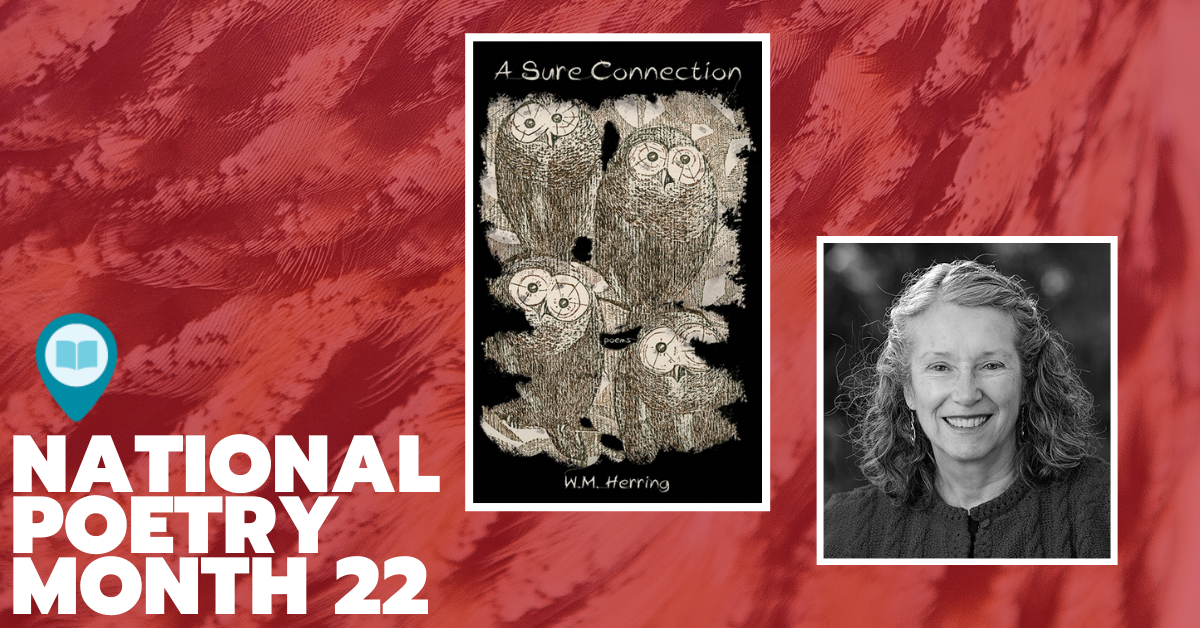
Rob Taylor: Birds of all types appear in A Sure Connection, including the four owls on the cover. Near the end of the book, you seem to acknowledge your obsession via a poem entitled “Another Bird Song.” Why do you think you write so much about birds?

W.M. Herring: I write about birds because I am an observer, and they are everywhere; if you frequent a fairly natural setting and are willing to stay still for a bit, you cannot miss them. Birds differ so much in habitat and habit, yet share so many characteristics. They behave as they were designed to behave, living in a manner that benefits their society. They exhibit beauty in such diverse ways. And, they can fly!

RT: You appear especially drawn to smarter, darker birds like owls and crows.

WMH: Both seem a cut above in complexity and in their ability to reward an observer for their attention. Crows certainly entertain and instruct; that makes them worth writing about. Owls attract because they are enigmatic, riveting, unexpected, otherworldly. An owl sighting pauses everything and makes me take stock of what else is happening, internally and externally, in that moment. I was excited to find Barred Owls in East Sooke as well as in Prince George. I hope the quizzical Barred Owls on the book cover make the potential reader (also) wonder what is within, while providing a broad hint that owls will be involved.

RT: Two other recurring sources of inspiration for the poems in A Sure Connection are photos and fields. The latter can be partially explained by your living at Gleann Eilg, an acreage in East Sooke. Both types of poems involve looking at a still surface and teasing out what’s hidden inside. Could you talk about these two types of poems in your book? What causes you to turn to fields and photos for inspiration?

WMH: I take very few actual photos, but I commit images and incidents to memory for later consideration. The “pictures” so created are starting points, places from which to tease meaning or share delight in the beauty. In “Swimmers,” I talk about my parents through photos that do not exist. What exists are stories they told me and things I observed. Those serve well enough.

The “Gleann Eilg” poems are written at our new place, an old sheep farm in East Sooke, over the course of a couple of years. The other outdoor poems are set almost entirely on a quarter section of overgrown farmland outside Prince George. Thanks to two children, some horses, and a few large energetic dogs, I spent forty years walking that land, watching its inhabitants and the land as it changed. Again, I stored up images and stories, apparently for the time I would finally start writing.

RT: What brought you to finally start writing?

WMH: Retirement brought with it the wonderful gift of time: time to walk slowly, to listen carefully, to contemplate; time to consider a stray thought or to research an event or historical figure; time to daydream; time to wordsmith over a mug of coffee for as long as it takes. In retrospect, I needed time to observe, absorb, and declare before I could produce even the shortest of poems. Until I had that time, I had no idea the writing that would emerge.

RT: Though you didn’t start until retirement, you’ve been observing, absorbing and declaring for a while now! In the acknowledgments at the back of your book, you list magazine publications going back almost a full decade. Did you find it tricky to pull together poems from a decade’s worth of writing, or had your style and themes stayed fairly consistent throughout?

WMH: I wrote my first piece, “Three Black Dogs,” in 2012, the same year it became my first publication in a literary magazine. Eight years later, I pulled the manuscript together. It wasn’t tricky to bring together poems over almost a decade because I am not a prolific writer. I picked poems I particularly liked and thought worth sharing (i.e. that others might find the time spent reading them worthwhile), whether they had achieved publication or not, and I had just enough for a manuscript. The book is a “collected” work — common themes such as family and place are simply common to my work as a whole.

I think my style had not changed much over the years because I started writing so late. My observation skills and worldview had sixty years to mature by then. My writing has become tighter, more spare, over the years; edits to poems in the final manuscript reflect that change and add consistency to the final product.

RT: Most of A Sure Connection feels firmly grounded in British Columbia, but hidden away in A Sure Connection are a number of poems set in far-flung places: Bangladesh, Colombia, England, Germany… And many of these poems seem drawn from your imaginings of historical events. Could you talk about these more wide-ranging poems? How do you think they complement the more here-and-now poems around them?

WMH: The more wide-ranging poems come from people or events, current or historical, that made me stop and think, which in turn made me write. I included them because the interpretation I put on the events is consistent with my worldview, so these poems give a deeper view into the writer’s mindset than a collection of just “family and field” poems could provide.

An important impetus for my writing was a desire to record some stories for my children. “The Councillor,” “Corn in Egypt,” “To The Shops,” “Died of Wounds” and “Swimmers” are among the family history poems. In their telling, they may help readers to recall, reflect upon, and share, their own family stories. 

RT: In the poem “The Red Journal,” you write about a book that functions as a “repository for fragments / one per scribbled line,” then provide examples like “snake closet / wood smoke.” I’m curious if this is a real book, and a real part of your writing process.

WMH: The Red Journal is a real book. In Prince George it sat on the breakfast table, at the window overlooking the backyard, forest and fields. The barn was just out of sight. In East Sooke it sits on my laptop table, at a window overlooking a yard, tall stands of trees and the Sooke Basin. As you know from the book, “snake closet” has already made its way into a poem (“Two Snakes”); “wood smoke” is awaiting a poem of its own.

RT: Is this how most of your poems start, in an odd word or phrase you catch and write down?

WMH: The poems start many ways — an image, a word or phrase, a story, a news headline (particularly the odd ones), a first or last line, an idea, a quote, even a poetic device. The germ of a poem is not the problem; bringing it to a meaningful completion is!

RT: One way you move your poems from germ towards completion is via comparisons, either in the poems’ content or structure. It’s right there in the titles of some (“Three Dogs,” “Two Snakes,” “Two Doors”) and also in poems divided into two parts, each providing a different look at the same thing. Still other poems are structured as numbered lists. Is this kind of itemizing and comparing something you pursued consciously over the course of writing this book, or just one of those little surprises that emerges as you pull a manuscript together? What do you think draws you to these types of poems?

WMH: Aha — you have found evidence and are looking for root causes! Good sleuthing. My brain is wired for logic — comparing and contrasting, counting, listing, parsing, ranking and evaluating. I have no training in Creative Writing, and no studies in literature beyond second year English. I have a degree in Computer Science and spent many years in software development, training, technical writing, and business analysis. Itemising and comparing is not so much conscious as inevitable. The result of all this: I find logical constructs pleasing. That and clean simple words, tight language. I am not completely left-brain, but there are those who would attest that I lean that way.

RT: Ha! Some poets could use their “left brains” more often — it might help me have a clue what they’re saying!

In “Singing” you write about someone singing while walking alone at their farm: “Why do I suppose joy / brings these songs? // She is singing to the bears.” I love the duality there, singing joyfully to the bears both to please them and to keep them away. I’m tempted to read “Singing” as a bit of an ars poetica: we poets keep death at bay by joyfully singing to it. Would you say that when you write a poem you are singing to the bears?

WMH: Your questions illustrated one gratifying element of presenting poems to others: the reader finds interpretations that the poet had not intended, or possibly just not noticed, but that work. I love that because it shows how utterly a poem can make the reader part of the process. The poem then carries different meaning for different readers.

Singing to the bears lets them know I know that I am in their territory, but intend them no harm. The song builds a congenial barrier. The poem sings to the reader, drawing them into the experience. The poem also sings because it calls out to be read and heard. You are never done with a poem (writing or experiencing it) until you have read it aloud or heard it read.

---

W.M. Herring was born in Quebec, grew up in Vancouver, and now lives at tidewater in East Sooke on Vancouver Island. Her work has been published in various literary journals including The Antigonish Review, ARC Poetry, Canadian Woman Studies, Literary Review of Canada and Queen’s Quarterly. A Sure Connection is her first collection.

7/25/2022

BC/AB Road Trip Report

Earlier this month, our family went on a little road trip through BC and Alberta. One of my favourite parts (behind only the water slides, mini-golf and dinosaur bones) was visiting book stores.

If you find yourself making a similar trip, here are three you shouldn't miss:


First up is Baker's Books in Hope, a used bookstore where every book is $2! They have a small but mighty poetry section, and a strong selection of rare poetry books at the back (they cost a bit more). Always worth a stop at the beginning of a road trip.


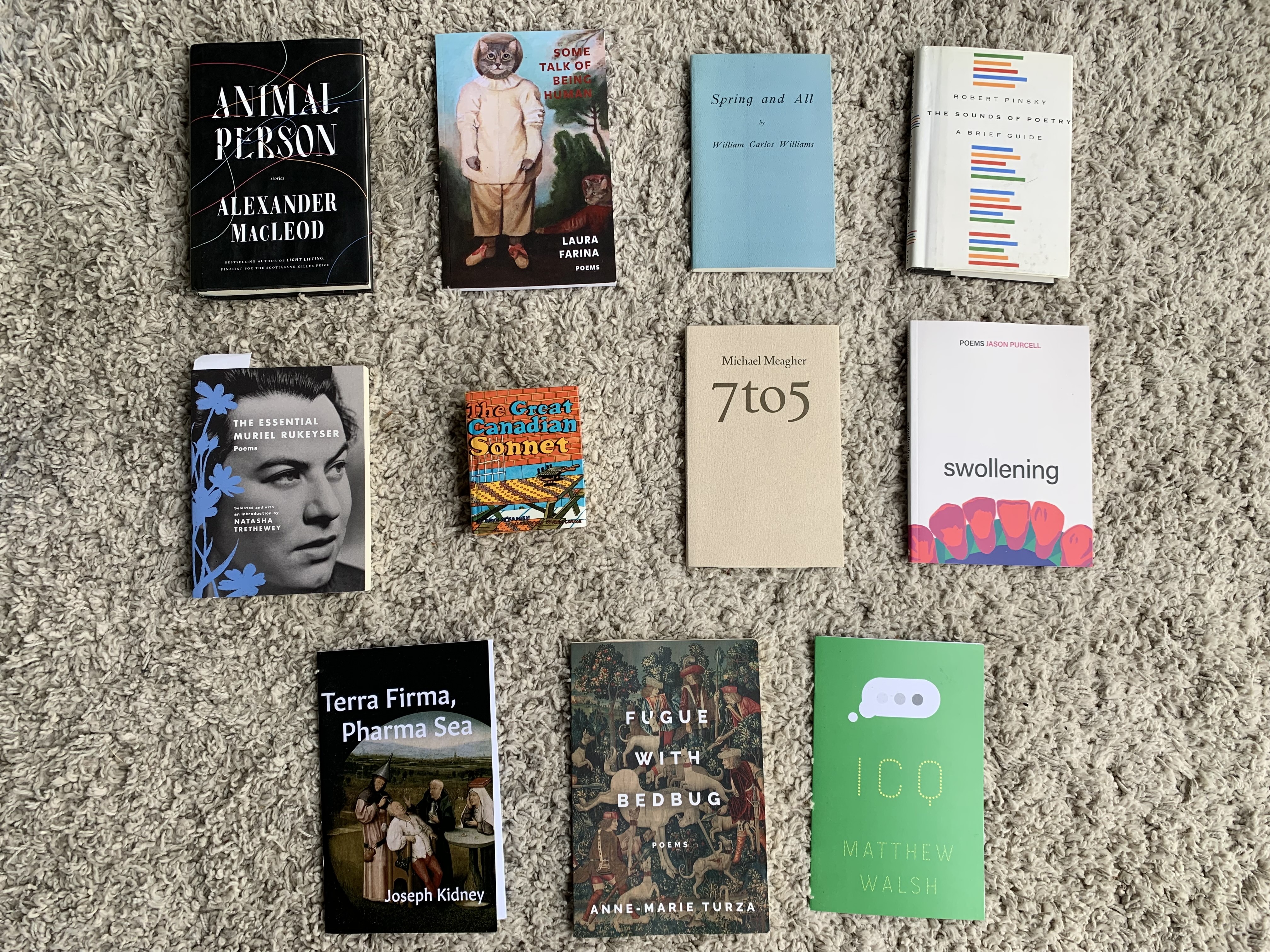
Another bookstore I'm always sure to visit is The Book Shop in Penticton. With over 5,000 square feet of floor space, it's one of Canada's largest. This time I counted 28 shelves of poetry, ten of which were Canadian (including Laura Farina's Some Talk of Being Human, photographed here). 


My tour of Alberta bookstores was truncated by our skirting around Calgary to avoid Stampede madness (and to spend more time hunting dinosaur bones), but I made sure we popped in to Glass Bookshop in Edmonton. Founded by poets Jason Purcell and Matthew Stepanic, it's an absolute heaven for poetry fans.


Right at the front entrance you're greeted by this fantastic array of (mostly poetry) chapbooks. 


And inside - boom! - eight shelves of brand new poetry, largely from Canada and the US. It doesn't get any better than this.

While I didn't get photos in other places, stores like the Wee Book Inn and Audrey's in Edmonton and Three Hills Books in, strangely enough, Three Hills, were also a pleasure to visit.


Here's the full list of the books I picked up on the trip, along with the bookstores in which I acquired them:

Animal Person, Alexander MacLeod (Iron Dog Books, Vancouver - picked up on the way out of town!)
Some Talk of Being Human, Laura Farina (The Book Shop, Penticton)
Spring and All, William Carlos Williams (Baker's Books, Hope)
The Sound of Poetry, Robert Pinsky (The Book Shop, Penticton)
The Essential Muriel Rukeyser, Muriel Rukeyser (Wee Book Inn, Edmonton)
The Great Canadian Sonnet, David McFadden (Wee Book Inn, Edmonton)
7 to 5, Michael Meagher (Wee Book Inn, Edmonton)
Swollening, Jason Purcell (Glass Bookshop, Edmonton)
Terra Firma, Pharma Sea, Joseph Kidney (Glass Bookshop, Edmonton)
Fugue with Bedbug, Anne-Marie Turza (Glass Bookshop, Edmonton)
ICQ, Matthew Walsh (Glass Bookshop, Edmonton)
Songs for Relinquishing the Earth, Jan Zwicky (Baker's Books, Hope - forgot it in the photo!)

A mere 12 books! My restraint grows with every year (or, at least, the space in our apartment diminishes). You can check out past trip book hauls here: 2011, 2016, 2017, 2019. God and COVID willing, I hope to be making many more such reports in the coming years!

7/11/2022

What Trickles Down the Line: An Interview with Ellie Sawatzky

The following interview is part one of a seven-part series of conversations with BC poets which I released between January and April 2022. All eight interviews were originally posted at ReadLocalBC.caThis was the third year of my collaboration with Read Local BC (you can read the 2019 interviews here, the 2020 interviews here, and the 2021 interviews here).

---


Sun Valley Lodge - Ellie Sawatzky

Somewhere in my mind, you’ve become
inseparable from the old boats, the plastic
Adirondack chairs. Listen, I saw plastic
Adirondack chairs long before I ever
saw you. I also saw red cars, fireweed,
deer in the road. I saw ukuleles and Amélie.
I rolled my own cigarettes, smoked them
alone, I crocheted poems to keep warm
at night before you, so step back, love,
this is my line of pine trees. This is my
soft light falling fast behind the lake.


Reprinted with permission from 
(Nightwood Editions, 2021)

---


---

Rob Taylor: A good number of the poems in None Of This Belongs To Me are set in remote locations: lakes, farms, tents, the Sun Valley Lodge, etc. I often think that poets who write about their immediate experiences have their lives distorted in their books: it looks like they’re always on vacation! The reality, I suspect, is that these are simply the moments in a poet’s life when they have the time and mental/physical space to write. Would you say that’s true for you?

Ellie Sawatzky: I actually tend not to write when I’m on vacation. I like to romanticize myself as the kind of writer who is overcome by inspiration, scribbling madly in the lounge car on the night train to Montreal. But in reality I’m too distracted in the moment, and I can’t process what’s happening to me while it’s happening. But I do take down notes and file away moments to revisit later, in my mind, when I’m at home in Vancouver at my desk. I write best in moments of quiet reflection when I’m feeling more grounded. I tend to explore my experiences “away” in my poems for reasons that are probably pretty obvious: they are times when something new has been revealed to me about the world and/or myself.

RT: One lens into the world, and yourself, in None Of This Belongs To Me is your work as a nanny. The third section of the book explores your time helping raise “B,” while you were still quite young yourself. You write “Grown-ups // made me, explained things like / sex and art and garbage. Lately I’ve been // explaining”. Later in that same poem you describe poetry as “the way the night / tries to make sense of its day”. Caring for a child and writing a poem both require a certain amount of “explaining” and “making sense” of the world. What was it like to be engaged in both processes simultaneously? Did you find that how you made sense of the world in a poem bled over in some way in how you made sense of the world for “B”? Or vice-versa?

ES: I think something that I’ve learned both from taking care of children and writing poetry is that some things just don’t make sense. Anyone who’s ever spent time around children knows what it is to ultimately answer a line of questioning with “I don’t know why, it just is.” It can be very humbling — and existentially terrifying — to admit that you don’t know something, or to acknowledge that there are multiple contradictory truths. In childhood so much is unknown and there are so many possibilities. As we get older things seem to narrow. But when you spend time with children, you connect with that sense of mystery and possibility and its inherent vulnerabilities, and this certainly inspired my poetic practice while I was working as a nanny. To me, poetry is a space that allows adults to ask questions the way children do. So it’s not so much about “making sense” as it is about wondering.

RT: In “Poetry Wants My Imaginary Boyfriends,” you write that poetry “wants me to malfunction perfectly forever.” You expand on that a few lines later: “poetry wants my ache and ache and a thumb / lost to frostbite.” We are certainly in a moment in poetry where, like the 6 o’clock news, “if it bleeds, it leads.” It feels like there’s an unspoken expectation that lyric poets will put the darkest moments of their life on display. You meet that expectation in many ways in this book, but you equally seem to resist the pressure: in their humour and surprising imagery and music, even the most difficult poems in None Of This Belongs To Me feel buoyed by lightness. Could you talk about that pressure to “malfunction perfectly,” and how you embraced (or rejected) it in this book?

ES: I think it’s important to be vulnerable when writing poetry, and I definitely feel that I followed that impulse in the poems in None of This Belongs to Me (how else to explain the massive vulnerability hangover I’ve been feeling since my book came out), and I also think that humour and levity are important when it comes to conveying meaning and connecting with a reader. Sometimes the process of writing poetry is a way to remind myself not to take myself too seriously. I agree that there are expectations around a poem’s content/tone/style, presuppositions about what poetry is and does, and in the process of writing this book I found myself embracing funny and joyful content — something I wish to see more of in poetry — alongside the more serious stuff. Part of that comes across as self-consciousness, I’m sure: in drawing attention to the process of writing a poem, pointing out its expectations and the ways in which those expectations are subverted. Poking fun at the process, even. For example, in “Ways to Write a Poem” (“Imagine how you might be murdered, but / make it beautiful”).

RT: The joy is there in the content of the poems, and also their playful musicality—rhyme and consonance in particular, especially plosive sounds like hard “t”s. Lines like “thistle-stitched ditch of adulthood”, or “a quivering / night lit occasionally by lightning”, or “a still moonlit / morning in Lillooet”, or “slips out into the wet knit of night / to unhitch the horse…” revel in plosives to an extent I’ve rarely seen in recent years (speaking of things we wish to see more of in poetry, that’s one of mine!). Could you talk about your interest in creating these dense sonic landscapes in your poems? How does this sound-making contribute to the sense-making of a poem’s content? 

ES: To be honest, I’ve never thought too much about why I do that, but now that I’m thinking about it, that kind of writing strikes me as being very “muscular,” so perhaps when I’m playing with language in that way I’m just flexing a little bit — constructing a moment where the imagery really packs a punch (pardon the plosive). It seems to me that these dense moments affect the pacing of a poem; they might force a reader to slow down a little bit, to linger on an image, to really hear it, or feel it in the mouth.

RT: Were you inspired by particular poets in writing in this way?

ES: I’m certain I learned how to do that from watching other poets flex their linguistic muscles. A few that I can think of include Ken Babstock, Ellen Bass, Sonnet L’Abbé, Liz Howard, Selina Boan, Adèle Barclay — and you, Rob!

That being said, my mother is a speech language pathologist, and I sometimes wonder if I’m a bit obsessed with the way words sound and feel in the mouth because of something that was instilled in me in the early years of language acquisition. 

RT: Yes, I think your mother deserves to be at the top of the list!

While many of the poems in None Of This Belongs To Me are united by their “muscle flexing,” some are much more plain-spoken. Other stylistic choices seem to shift from poem to poem, too: in the book’s fourth section, for example, we start encountering poems written entirely in lower-case letters and in shorthand (“u” instead of “you”, etc.). Some poets have a singular style, while others seem to decide anew their style from poem to poem. Where would you put yourself on that spectrum? Do you write in one “mode” for extended periods, or are you starting fresh with each poem, or somewhere in between?

ES: I would say I decide anew with every poem. I often worry about being repetitious with my poetry, or hitting the same note too many times, so I’m always switching it up. Over the ten years I spent writing this book, I’ve tried a lot of things. Some have worked, some haven’t. This is a collection of what’s worked. It’s a wide spectrum of practice. The oldest poem in the book is “The Boy Next Door,” a narrative poem that is arguably more “conventional,” and tonally it’s very heartfelt and sincere. It almost reads like a short story. And the newest poem in the book is “Blessings Upon U and Ur Bullshit,” in which I’ve tried something new with lower-case letters and shorthand, but also with form and tone; it’s more playful and sassy. I think it’s cool to put those two poems beside each other and imagine the ten-year journey it took to get from one to the other — both in life and in poetry.

In recent years I’ve landed more comfortably in myself as a poet — which is to say I have a better understanding of what I like and why I like it. For example, I like reading and writing poems that don’t use conventional punctuation, because there are more opportunities for experimentation: word play, double entendre, etc. So maybe there’s more stylistic consistency in the work I’m producing nowadays. But I still like each poem to be its own being.

RT: I’m not sure if it’s one of your older or more recent experiments, but one recurring “shape” to your poems is what I’ll call “shrinking quatrains,” in which each line of the stanza is noticeably shorter than the one before it. In your endnotes, you credit a Ken Babstock poem for inspiring the shape of those poems. What drew you to that form originally, and what kept you returning to it? Are there other shapes you often find yourself returning to?

ES: “Shrinking quatrains”! Yes! I’ve been looking for a name for that particular shape. I really love the Ken Babstock poem that first inspired that shape (“Carrying Someone Else’s Infant Past a Cow in a Field Near Marmora, Ont.”); the content of that poem was evocative for me too, and reminiscent of my own experiences with other people’s children. I loved how the shape seemed to reflect lineage, the ways in which a young child is influenced by what has come before—what trickles down through the line, what is retained, what is forgotten, what makes an impact even if it isn’t remembered.

The first poem I wrote in that form was “This Little Girl Goes to Burning Man,” and at the time Ken Babstock was my poetry instructor at UBC. I remember him telling me, after the poem was workshopped, that if I’ve found a shape that works, to write more poems in that shape. I really took that advice to heart. I wrote “Crystals” a while after that, and then “Kenora, Unorganized.” I’m sure it’s one I’ll return to again in the future.

Another shape that I find myself returning to is one I’ll call the “indented couplet” (“New Moon, Gemini Season” and “Self Portrait as Ostrich”), where the second line of a couplet is indented and often shorter than the line before it, and each couplet sort of bleeds into the next. This is one I made up, and it’s reflective, for me, of the natural stream-of-consciousness rhythm of my brain, aka my failed attempts at compartmentalization.

RT: Another form that runs with a bit of a “stream-of-consciousness rhythm” is the list poem. None Of This Belongs To Me features a number wonderful ones, including the powerful opening poem “Overnights at the Hospital.” What draws you to write about certain experiences in list form instead of a more narrative approach? Are there certain subjects that you find more conducive to the form?

ES: If I don’t know how to start writing or what to write about, I write a list poem. Usually it’s a kind of free association exercise. I find list poems easier to write than other kinds of poems, probably because of the free association aspect. It makes it more fun, like a game almost. It gives me more freedom, too, maybe because it isn’t tethered to a narrative arc. A list poem is like a movie montage, where each little scene or image is a story unto itself. 

I don’t do a whole lot of planning or thinking about what I’m going to write before I write it, but in retrospect the featured list poems in None of This Belongs to Me all tend to cover vast swathes of time and move between childhood and adulthood, so there’s something there… Perhaps list poems work well when I want to pull back the lens and move through time in a different way.

RT: What’s the key to writing a good list poem? Once you get writing one, how do you know when to stop?

ES: I think the key to a good list poem is surprising the reader, whether that’s by using a particularly provocative image or by playing with cadence/rhythm/pacing in such a way that you subvert the pattern that’s been established. That could be done by playing with enjambment, cultivating breaths and beats between lines, mixing up short lines and long lines — or using short sentences after a long one.

There always seems to be a natural place to end; I tend to arrive at a breaking point, and then there’s a denouement, a slowing to a stop.

RT: Subverting the pattern—yes! I’m glad you said that. I’m interested, too, in this idea of a list poem as a movie montage. Many of the poems in None Of This Belongs To Me feel cinematic to me, especially in their compelling closing images: the boy across the frozen water “going into / the lit house” at the end of “The Boy Next Door,” or the family in “Recalculating” who arrive late at a Days Inn, switch off their bedside lamps, and “blink in the black room / like mice.” I could easily see some of your poems being turned into short films, the final image before the fade-to-black already set in place.

Could you talk about the relationship between narrative and image in your poems? Do you more often start with the image, and build toward the story, or vice-versa? Another way to put it: in your narrative poems, do you think of yourself more as script-writer or cinematographer? Or, looping back to our discussion about sound, perhaps more film composer?

ES: Someone please buy film rights to my poems! I definitely think of myself more as a cinematographer. I also write fiction, and my approach to a poem is much the same as my approach to a short story. I almost always start with a landscape, character or image and then the narrative unfolds from there. For me, writing a poem is more about telling a story than it is about exploring a concept or theme the way a lot of poets do.

RT: Ok, let’s end things with a Very Important Question: you reference Tom Petty in two different poems in the book. I love Tom Petty as much as the next person, but still an explanation seems in order…

ES: I had to go looking for the second reference to Tom Petty in my book (in “Spotify My Body”). It wasn’t even really on my radar. Ha! I guess Tom Petty lives in my brain rent-free.

Funnily enough, there was actually a third Tom Petty poem that got cut from my manuscript — one that I wrote when I was asked to perform at Mashed Poetics a few years back. The album we were “covering” that night was Tom Petty’s Full Moon Fever. I wrote a poem after “Feel a Whole Lot Better.” And I dressed up as Tom Petty for the performance—I had the right sunglasses and the right haircut. The resemblance was uncanny.

Okay, so I’m a Tom Petty fan. My parents listened to Full Moon Fever A LOT when I was growing up, so it’s very nostalgic.

RT: Ok, I’m going to need to see a photo…

ES: Boom.


---

Ellie Sawatzky is a writer from Kenora, ON. A finalist for the 2019 Bronwen Wallace Award for Emerging Writers and the recipient of CV2’s 2017 Foster Poetry Prize, her work has been published widely in literary journals such as Grain, The Fiddlehead, PRISM International, The Matador Review, The Puritan and Room. She works as an editor for FriesenPress, and is the curator of the Instagram account IMPROMPTU, a hub for writing prompts and literary inspiration. She holds an MFA in Creative Writing from UBC and lives in Vancouver.

6/27/2022

Suspension, Some Dread, A Lifeline: An Interview with Neil Surkan

Reservoir – Neil Surkan

Carp lurk through suburbs
when runoff jumps the dam, sucks
manhole covers up like corks, slops
wallpaper with septic hands.

I mostly keep my body close – rove,
but rarely quit, its cul-de-sacs –
save in, say, a dense flicking
stand of thin birches, their tigered

stalks quivered by the spring
wind, cool light trickling
through the tossing stems.
Then, if lifted, if moved

to swim among the future
sprigs, balled now in burgundy-
armoured buds like tiny
minarets, I see it all

without me – abandoned nests,
old anthill pocks – and am re-
minded that the verb to be
gears down but never loses speed

completely. I am not undying,
nor ever pre-bloom, just
a reservoir of energies
that pour in, spool around me, stream

in floods of words that,
like fish scales on furniture,
cling for a while and shine
the dull way dried tears shine.


(McGill-Queen’s University Press, 2021).
Reprinted with permission.

---

Neil Surkan was born in Penticton, BC. He is the author of the poetry collections Unbecoming (Fall 2021) and On High (2018), both from McGill-Queen’s University Press, and the chapbooks Their Queer Tenderness (Knife | Fork | Book, 2020) and Super, Natural (Anstruther Press, 2017). Neil earned a PhD in English from the University of Calgary in 2021. He currently lives and teaches in Nanaimo, on the traditional and unceded territory of the Snuneymuxw First Nation, with Luca, Edi, and Lloyd.

---

Rob Taylor: Unbecoming opens with a wonderful epigraph:

To be coming apart.
To be, coming apart.
To becoming, apart.
To becoming a part.

This speaks so well to many of the poems in the book, including “Reservoir,” where you use a first-person narrative to question the self, the ego to take the piss out of the ego. This theme was also present in your first collection, On High (its cover an ant towering like royalty on top of a thimble), but it felt less central. Could you talk a little about this theme of “coming apart” in order to become “a part,” and how your thinking on it may have shifted or expanded between books one and two?

Neil Surkan: When I was in my early twenties I drew a comic for a friend of a dejected, ovular guy. It was captioned, “All his life he strived to be well-rounded. Now he never has an edge.” The comic was, up to that point, the truest thing I’d ever written about myself. Likeability was a very important trait to my parents, and I was raised to be obedient, competent, and extremely extrinsically motivated. When I started reading poems in earnest at nineteen, I was inspired and flummoxed by the way original language diverges from likeability: the poems that drew (and still draw) me refused acquiescence and revealed how disingenuous obedience can be.

At that same time, I was starting to figure out I was queer and punishing myself for it because I was worried the people I’d grown up with would reject me or only see me as queer (like it’d explain everything). On High pokes around in that substrate, but it wasn’t until I learned I was going to be a dad midway through writing Unbecoming that I truly stopped aiming to “please,” both in my life and in my poems (there’s no distinction—ha), and started interrogating the beliefs I’d perhaps misunderstood about what it means to be a community member. How might I contribute by being myself, instead of who I think people want me to be? I love On High and I love how in love with poetry (and invested in pleasing the poets I love) it is, but I think that Unbecoming is my first unapologetic collection—the one that affirms the ego before playing around with (and sometimes shattering) it.

RT: I love that you start from a place of honesty, acknowledging the ego. Elizabeth Bishop once did the same, saying “there must be an awful core of ego somewhere for you to set yourself up to write poetry.” The tension between the ego-stripping desire to “unbecome” and the ego-preserving instinct to write poems (“Gather round, I have something to say!”) is present in a many of your poems.

NS: It’s funny that you’ve quoted Bishop to opens a discussion on ego and permanence, because I have her face tattooed on my leg.

RT: What? Ok, I’m going to need a photo…

NS: 

RT:
Ha! Amazing! If only Elizabeth could have seen that tattoo—how her awful core of ego would have swelled! How do you reconcile your “awful core’s” desire to last with your desire to “unbecome”? Does your thinking along these lines ever tip you toward writing less? To silence?

NS: I try to write with the poem’s (and my own) inevitable collapse into silence in sight, and some days I choose silence (or, I get so overwhelmed by trying to write something perfect that silence chooses me). Bishop is one of my favourite poets so I feel weird saying this, but I’d quibble with her word choice in that quote: to “write” poetry can be, I think, a kind of prayer—a rummaging through one’s experience of the world via language’s precarious, imperfect, evasive scratching. Publishing poetry, on the other hand: yeah. That’s an ego imbalance, especially when it comes to questions of audience (I often write to poets I’ve never met, for instance: the gall!).

That said, I can’t help but believe that publishing writing isn’t just ego-stroking: practicing relinquishment of a finished creation can be a valuable way to live, no? Likewise, surely it’s reasonable to do something with intention and extreme attention while accepting its imperfection. That’s my justification, anyway, and it’s why I choose poetry over, like, Twitter: to me, poetry is the most demanding genre in terms of how many times one agonizes over punctuation, or rhythm, or suggestion. People who Tweet in a diary-like fashion terrify me (except for Henri Cole: Henri Cole’s tweets are the most generous, gorgeous hymns to life) because I find it almost impossible to trust someone who can rattle off words on their phone without suffering over every syllable (and savouring the suffering).

Bishop’s ending to her elegy “North Haven,” for Robert Lowell (who was a perpetual reviser), speaks to the interplay of futility and hope I feel when I’m writing: “Sad friend, you cannot change.” Language is imperfect, its exact effect on another human can never be absolutely confirmed, and yet to publish, in particular, is to accept that something that could have probably been made better will persist so long as someone has the book. I often choose silence, but I also try to remind myself that it’s okay to make mistakes, or at least missteps, while working through an idea, if only because the associative, generative time of writing poetry is also, for me, the time when I feel consistent astonishment. Rummaging through lines until something unexpected happens may be a sign of ego imbalance, but it can also be a relegation of the ego to the backseat.

RT: That’s a wonderful way to put it. I like the idea of moving deeply into a poem as involving the steady demotion of the ego: from the driver’s seat, to the passenger seat, to the back seat, until you ditch it at a gas station (to be picked up again, soon enough).

Now that you’re a dad, you’ll soon have lots of practice dealing with someone who won’t shut up in the backseat! The third poem in Unbecoming is about becoming a parent, and is delightfully titled, “My Favourite Death Sentence.” In “Shore,” you write about an ultrasound: “I’ve a new, / unfurling sense… of the sounds under silence.” You mentioned that becoming a dad caused you to stop aiming to please. Could you expand on that? How has parenting helped you “unbecome” and “become a part”?

NS:
I think the stakes of the poems in Unbecoming got higher when I learned I was going to be a father. In reflecting on the morality of bringing another life into the Anthropocene (or, more aptly, the Necropastoral), I was forced to directly confront comforts and complicities I had downplayed all my life. The selfish act of creating another human inspired me to consider the possibility of self-less nurturance. Suddenly having a significant stake in the generation to come meant imagining the world beyond my lifetime—no matter my idiosyncratic beliefs and oft-insular routines—and so a newfound sense of accountability awoke.

The collection’s opening long poem, “The Minimum,” explores both the optimism and complicity I felt when I became a father by inhabiting the space between becoming a part of my father’s family line and breaking apart from our family. In particular, I wanted the poem to examine, rather than condemn, the patriarchal family structure in which my father and I were raised. “The Minimum” is a poem that struggles with the interplays of complicity and loyalty, conscience and tradition, and, thereafter, the rest of the collection expands around its (implied) question: what beliefs will my son one day critique me for upholding due to my own failures of self-reflexivity?

RT: Themes of conscience and tradition also come up in your poems on religion and religious doubt, which appear in both your books, but feel more pronounced in Unbecoming. “Faith,” for instance, has its speaker on the lawn in search of a sprinkler head: “Even as the clouds give and drops / of doubt accumulate, / I can’t stop crawling.”

I’m a minister’s son and I’ve come to learn that PK (“Preacher’s kid”) poets, and other poets who were raised in a church, are a common phenomenon. You make this connection, too: in a poem in On High, the religion and poetry sections share an aisle in the library. Could you talk about the interconnections between poetry and religion in your life? Does faith in one compensate for your doubts in the other? Or are the doubts shared around more evenly?

NS: After my MA at the University of Toronto, I seriously considered becoming a minister. The job seemed marvellous in the way it combines performance, careful reading, community building, and spiritual accompaniment. The only problem was (and is) that I don’t (can’t?) believe. Faith evades me. Most of the meaningful experiences in my life have been ineffable, so The Word can’t do the heavy lifting, but it’s my hunch that if a minster were to begin with a preamble about how incredible it is that words almost exclusively fail us, the majority of their congregation would boo and depart. On the contrary, I love poetry precisely because the art form depends on the acknowledgement of the imperfection (and failure) of its medium. A poem that doesn’t attempt to adjust for its patchy communication, and for the problem of speaking to and for others, usually devolves into assertions and truisms (which is what I’ve experienced preaching as, mostly). Or, more simply put, a poem that lets an acceptable amount of wonder in gets productively blown open by a whopping dose of doubt.

RT: My father worked in the United Church, and talking with a number of his colleagues I came to the conclusion that the ministers had more doubts than their congregants. You might be right about the booing, but you probably could have bluffed and gotten away with it! “Bluffs” of all sorts abound in Unbecoming: both hill cliffs and the fakes and feints of animals and people. You even have poems entitled “Bluff (I)” and “Bluff (II)”! Seeing through one’s own “bluffs” to reveal the true self seems to naturally fit within the book’s themes. Was this something you planned, or a surprise you came upon in pulling the manuscript together?

NS: When I put the first “full” draft of a new manuscript together, I love to spread all the pages out on the floor (and surrounding furniture) and then physically move the poems around. That moment marks the break from “writing poems” to “making a book,” and it’s a ritual I adore specifically because it draws my focus upward/outward—toward the sleight of hand that can be done in sequencing. I really appreciate that you pointed out the “Bluff” poems because their separation in Unbecoming (they were written back-to-back but appear quite far apart in the book) marked an important shift in the ordering of the collection: placing them apart felt a little sly, a little playful, as though I was giving myself permission to bluff on the level of organization.

Rae Armantrout’s collection Versed does this feinting echo chamber trick I really admire and often return to, where in one poem there’s a buzz and then a few poems later BEES appear. The first time I read Versed, I felt both inspired and overwhelmed by the possibilities of organizing a collection as a series of ripples and echoes that exist without being explicitly articulated, like a mind not wholly made up, or a cluster of evidence with its purpose unstated.

RT: Yes! Robyn Sarah once told me, “sequencing a collection is like writing one last poem, which is the book itself,” but I think she undersold her case. The sequencing in a well-wrought book like yours is worth, hell, at least five poems!

The attention you give to sequencing is exceeded only by the attention you give to your individual poems. I love especially how many of your poems end. Jack Gilbert once said, “If I’m writing well [a poem] comes to an end with an almost-audible click.” Your “click” often comes with a rhyme, rarely a perfect end-rhyme like the rhyming couplet that closes a Shakespearean sonnet, but something that’s a bit more ragged, reaching back maybe two or three lines to some unexpected word. What draws you to this type of ending? Did writing in this style come naturally to you, or was it something you saw in others and wished to emulate?

NS: When I was 12 or so, my dad took me up to a half-finished house being built on our crescent so we could check out the floor plan. The insulation hadn’t been inserted, so the walls were just studs. We walked down a hallway and I stepped into the hole where the staircase to the basement was going to go. My dad caught my elbow as I hung over the void. That’s what a good ending to a poem feels like: suspension, some dread, and a lifeline.

I love poems that end with a near-resolution, or a statement that makes sense in a “peripheral vision” sort of way (like, if you look a little to the left you can almost glean the rationale). Gilbert is a good example: so often, the thrust of his poetry verges on familiar sentimentality, but then he frays convention to its limit. His speaker’s personal grief transforms into sprawling, savoury, wonderful existential terror. In line with Gilbert, I try to make my poems’ music resonate in the holes left by withheld pieces. Micro-devastations. Clapper-less bells. The “click,” for me, happens when I get a hunch that the last line couldn’t be anything other than what it is, even though I never saw it coming: half-confusion, half-satisfaction, a distant cousin of comfort.

RT: “A distant cousin of comfort”—oh, I love that! I’m reminded of Philip Larkin’s “almost-instinct almost true” that “What will survive of us is love” in “An Arundel Tomb.” Reaching for something we can’t quite reach, and the music we make in trying.

You talked there about “the holes left by withheld pieces.” Earlier you spoke of how it was in Unbecoming that you became more confident writing about being queer. A year before Unbecoming was published, you released a chapbook with knife|fork|book called Their Queer Tenderness—I suspect that was part of that process. How did preparing the chapbook, and working with Kirby at knife|fork|book, help you think about the larger collection to come?

NS: Their Queer Tenderness was originally titled Desire Path. Kirby, a dear friend, contacted me shortly before the collection headed to press with word that another Canadian press was publishing a poetry collection titled Desire Path in the same season. When Kirby suggested we revise the title to Their Queer Tenderness (a line from my poem “Outposts”), I felt the world swoop in—part of me screamed FUCK NO: if we call it that…strangers will…know I’m queer. I am forever grateful to Kirby for myriad reasons, but the title change suggestion is right at the top: Kirby made space for me to be seen as I see myself at a time when my queerness felt like an ice cube that had melted almost to nothing. Parenthood, living in Calgary—it was becoming easier and easier for me to appear as a straight dad. And until the chapbook came out, I hadn’t realized how stifling that felt. The way desire works in my poems makes a lot more sense, I think, now that Their Queer Tenderness exists.

RT: “Yes, as is often the case with desire, / it swerves suddenly, / got shy,” you write in “Desire Path.” I wouldn’t say that that poem, and others in Unbecoming, are “shy” about your queerness, but they are subtle. That said, so are most of your poems about parenthood, religion, etc. —as you say, they withhold pieces. To what extent would you say the subtleness of the queer themes in your poems is tied to that “FUCK NO” instinct? To what extent is it a manifestation of your general aesthetic leanings towards subtlety?

NS: At this point in my life, poems that contain the “FUCK NO” instinct are memory-poems that meditate on past shame and fear, rather than on the way I feel about my queerness presently. However, in my poems I generally prefer suggestion, and the way suggestion can elevate attention. In turn, I’m interested in the ways queerness can inflect, rather than direct, description or intimation: for instance, how desire can recalibrate the depiction of a friendship without overtaking it. Or how being bisexual, in my own life, makes quiet alienation creep into a poem’s scenes of communal space or collective action. Some of Carl Phillips’s poems have been a huge influence in this regard (although celebrations of physicality are also an important part of his poetics). Julie Joosten, too: she is, in my opinion, the most undercelebrated living poet (I am repeatedly agog at both Light Light and Nought). Other influences include Mark Strand’s prose poems, early Daphne Marlatt, and Mary Jean Chan.

RT: Does it get any better than Carl Phillips? And I’ll need to check out Julie Joosten! Has how, and how openly, you’ve written about your queerness continued to evolve since the publication of Their Queer Tenderness and Unbecoming?

NS: Majorly. The longer I live, the more in love I feel with the life I chose to make from the materials I was given. The tenderness keeps expanding!

But that’s also why, I think, my poems keep getting sadder and, probably, sourer. I’m increasingly heartbroken by disparities of all kinds, but especially the disparities of tenderness I witness around me every day.

RT: Sadder, maybe, but I wouldn’t say sour. More open and honest.

We’ve been talking about influences and editors. You’ve been lucky to work with a number of talented writers, including your editor for both books, Carolyn Smart, and fellow BC-turned-Calgary-poet Larissa Lai. I once heard you say that Lai convinced you to move “The Minimum” up to the front of the book (long poems more traditionally being tucked further back in a book, to not intimidate readers!). I thought that was a wonderful decision, as it set up these two pillars—your grandfather’s death and your child’s birth—that hold up everything that follows. Could you talk about the role of editors and readers in your creative process? How have they helped you see your poems and books in new ways?

NS: When I get the opportunity to share my poems-in-progress with someone I truly admire—like Larissa, like Carolyn, and like the friends I feel safe to request feedback from—I get overwhelmed with gratitude for their attention. Attention is a precious, finite resource, and I try to always remind myself that if another poet spends their attention reading my poems, they’re reducing the amount of time they get to work on their own. That’s huge, and immensely humbling, and I do everything in my power to not take it for granted. I’ve learned so much from mentors, editors, and close poet-friends alike about both the possibilities of poetry and the complexities of relation: to edit someone else’s poem with the intention of helping it be itself more clearly, rather than with the intention of making it do what it “should,” involves deep, active listening and observation.

When Larissa suggested I move “The Minimum” to the front of Unbecoming, for instance, I felt heard and cared for in a rare and energizing way: she’d not only engaged with my poems so actively that she’d noticed resonances I might never have arrived at on my own, but she’d also invested herself in supporting my work to such an extent that she’d seen a better version of “my” book! That “my” is really important, there, because it’s a misnomer: the book is ours, now. Unbecoming would have been something different without Larissa (and Carolyn, and the myriad friends who added their input throughout the process). For me, collaboration is a sacred part of writing.

RT: Unbecoming’s dedication page features an epigraph from our pal Jack Gilbert: “The painful love of being permanently unhoused.” In comparing your two-book, On High felt very firmly grounded in the Okanagan, while Unbecoming's connection to place feels looser, broader. A sense of feeling “unhoused” seems to speak to so much of what we’ve already been discussing, but on a more basic level, also simply about your moving about (from the Okanagan, to Calgary, and now Nanaimo). Has your sense of “home,” both what it is and how to write about it, evolved over the years? In what ways is it connected to your broader considerations of the self?

NS: I find it almost impossible to write about where I am living. Instead, I usually wind up writing about places in retrospect: it’s often as though old homes, or at least places where my body was, take a long time for the associative parts of my mind to process. Especially because I often begin a poem with a phrase or image knocking around, the place fills in around the phrase or image, adding details and fragments of memory until I get a better sense of what the poem is getting at.

Take the title poem in Unbecoming: the first line, “Night advances like molasses,” started clacking around my head, and then a few weeks later I saw that creeping darkness from the vantage point of Munson Mountain in Penticton, looking across to what used to be the Peter Brothers gravel pit. When a poem appears in this way, questions of accountability sometimes sharpen into focus, too: I wind up thinking about how I behaved in a given situation (or how I heard someone else behaved—I love bringing in snippets of gossip). Then I pose it (as question, as posture) in the poem.

Presently, what I really want is a community to get invested in long-term, so that writing and living synch up a little more (though it’s possible I’ll keep writing about places I used to call home instead, as they glimmer more and more faintly in the past). I deeply admire how someone like Alex Coleville stayed mostly in one place and made place-specific art all his life.

RT:
In your books the Okanagan comes across as a place of collective embarrassment and personal significance. Rich and tender and humiliating all at once. Having now lived in Alberta and on the coast, it seems like you’ve experienced two extremes (of culture, climate, politics, etc.) which converge in the Okanagan, both metaphorically and literally: the main sources of the vacationers who pour in each year! How do you feel about Penticton and the Okanagan now?

NS: I was born in Penticton because my grandparents on my mom’s side moved there: they thought the Okanagan was Heaven on Earth. My parents followed because they agreed. Yes, the Okanagan is Canada’s Florida (in the worst ways), but whenever I feel disdain for, like, the fact that you are still very likely to hear Eminem’s “Without Me” blaring unironically from a car down by the beach, I remind myself of how my grandfather, in particular, would treat every moment he ate a peach in the summer, or every moment he sat out front of his Scamper camper by the channel in Oliver, like the best scenario available to him in the entire world. His certainty was justified: he’d grown up brutally poor on the prairies, worked doggedly all his life, and now had made it. I try to splice my own oft-painful memories and sardonic observations of Penticton with vignettes of him feeling unabashed satisfaction because I respected him so much.

RT: Your grandfather is quite present in Unbecoming, most notably in the aforementioned long poem, “The Minimum.” Could you tell us a little more about him, and how his life and death shaped your thinking in the book?

NS: There are actually two grandfathers in Unbecoming: my father’s father, the focus of “The Minimum,” and my mother’s father, who played a much larger part in raising me, who was incredibly kind, and whom I found it very difficult to relate to because he never seemed interested at all in art (he was a practical and dependable former railway supervisor). I let them blur together across the poems, but I want to acknowledge that they’re both a part of the book. My father’s father, the focus of “The Minimum,” wrote his autobiography by hand (in a frenetic, near-impenetrable scrawl) in the months before he died. Typed out, it’s about one and a half pages long, and mostly lists his achievements as a physician. It does, however, reference the brutal poverty of his upbringing, and the fact that he became a doctor much later in life because of the war and his responsibilities on the family farm. As a child, I admired his matter-of-factness, though I found him intimidating and perplexing—except for when we were trolling for pike on Waskesiu Lake. I’m pretty sure we both enjoyed that. Troll fishing aptly illustrates our relationship: I felt like I was constantly towing a hook through the water, waiting for it to snag something definitive I’d be able to engage with. I also have a distinct memory of him looking extremely disappointed when I gagged while gutting my first fish.

RT: In a poem in On High, “Ars Poetica,” you compare poems to terrariums in which the speaker tried to “[make] creatures thrive.” In your first book you play with a number of personae and voices—little terrarium worlds, in a sense—while the poems in Unbecoming feel more in the shared voice of one speaker (Neil Surkan himself!). These new poems feel less constructed in the head than written from the gut (and, presumably, they were written more quickly, as your books come only three years apart). Would you say there’s something to that assessment? If you wrote your “Ars Poetica” today, how might it be different?

NS: I think that’s true. Maybe put even more frankly, I felt more confident writing Unbecoming. And I guess that’s how my “Ars Poetica” has changed, too: I think of poems now as my best crack at communication, rather than as intricate arrangements or sleight-of-hand suggestions. The poems I’m writing now, and the poems I want to keep writing (for the time being), brush aside the instability of language instead of obsessing over it. They still posit the precarity of speaking about anything, but there’s also an element of, “Ya ya, sure, language is ‘faulty.’ I still really want to tell you this.”

---

You can let Neil Surkan tell you stuff (and you should!) by picking up a copy of Unbecoming at your local bookstore, or via the McGill-Queens website or, if you must, from Amazon.